
Why the laboratory method matters
A clinically useful result depends on the sensitivity of the method, on standardisation and on traceability to the WHO international standard.
What an IgE testing system has to solve
Several important factors have to be taken into account when developing a system for testing allergen-specific IgE antibodies.
First, there are five different classes of immunoglobulin, and any effective testing method must be specific for IgE, without interference from the other antibody classes.
IgE is 200,000 times rarer than IgG

IgE is present in very small amounts in human serum compared, for example, with IgG levels, which are roughly 200,000 times higher. This means that any high-performing testing platform has to be very sensitive.
In addition, allergens do not share a common structure and can come from a wide range of allergen sources. Even the same allergen source can vary in protein content depending on biological factors, including the diversity of patients’ IgE specificities, or on geographical variation.
Standardisation and traceability
ImmunoCAP™ is calibrated against the WHO international reference preparation for human serum IgE, which is why results can be reported quantitatively, in internationally standardised units.
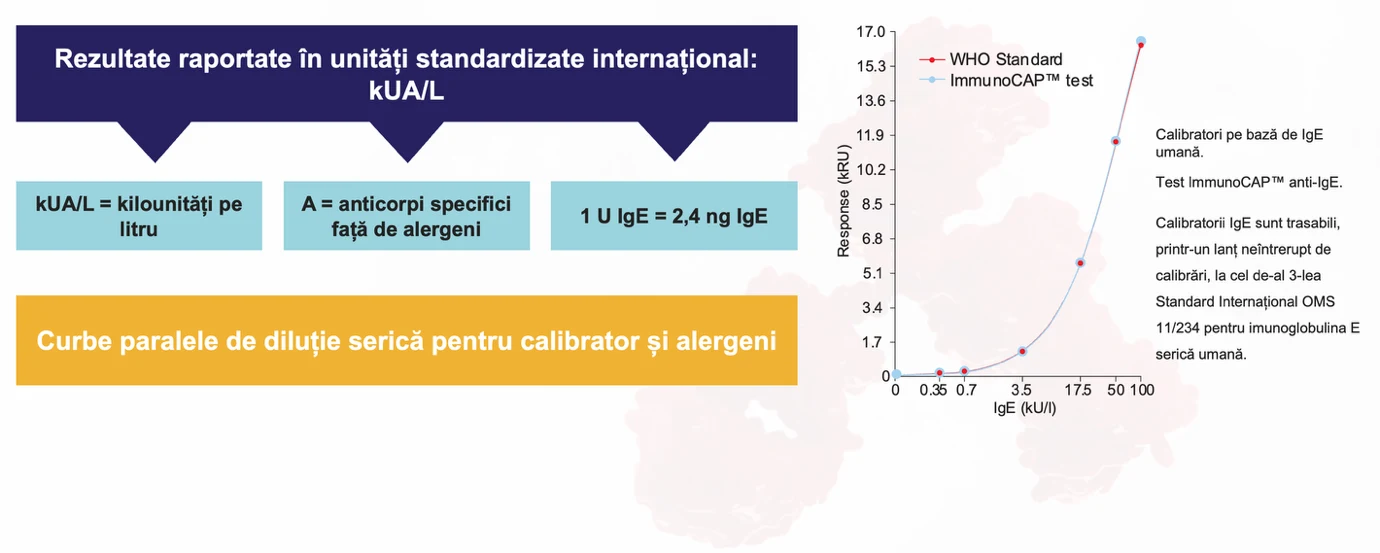
- Total IgE concentrations are usually expressed in kilounits per litre, kU/L.
- For specific IgE, the index A is added, giving kUA/L, where A stands for allergen-specific antibodies.
- One unit of IgE corresponds to 2.4 nanograms of IgE.
Why a low limit of detection matters
The low limit of detection of ImmunoCAP™ technology, 0.1 kUA/L, makes it possible to identify specific IgE sensitizations at low values, below the classic reporting threshold of 0.35 kUA/L.
This is an important advantage in the assessment of paediatric patients, where IgE levels can be lower, the clinical history is often difficult to interpret, and early, clinically correlated detection of sensitization can contribute to finer diagnostic stratification and to better individualised management.